

 Vn
Vn





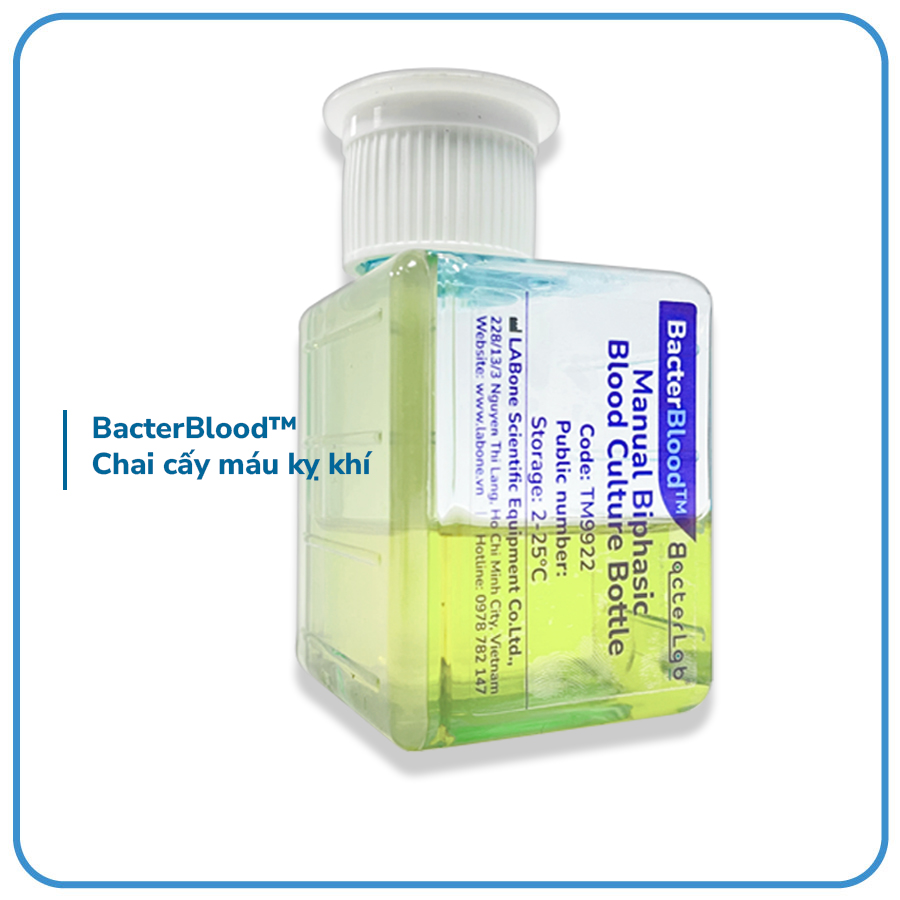
BacterBlood™ Anaerobic Blood Culture Bottle
- The medium is used for performing blood culture tests to identify the causative agents of bloodstream infections.
- Code: 02002
- Packaging: 10 plates/box or as per customer requirem ents.
- Storage Conditions: 4 – 25°C. Avoid the light.
- Transportation: Ambient temperature.
- Shelf Life: 06 months from the date of manufacture.
INTENDED USE
- BacterBlood™ Anaerobic Blood Culture Bottle is designed for the isolation and detection of anaerobic microorganisms in blood samples. It provides optimal conditions for the growth of obligate anaerobes, ensuring accurate diagnosis of bloodstream infections such as anaerobic bacteremia and sepsis.
PRINCIPLES
- The bottle contains Thioglycolate and L-cysteine to create a reducing environment for anaerobic growth.
- SPS: Prevents blood clotting, inhibits phagocytosis, and neutralizes antibiotics.
- PABA: Neutralizes sulfonamide antibiotics.
- Sealed system: Ensures sterility and compatibility with automated blood culture systems.
- This formulation enhances microbial recovery while minimizing contamination risks.
- Inspect the bottle for contamination or damage. Label appropriately and remove the protective plastic cap. Disinfect the rubber stopper with 70% alcohol and let it dry.
- Collect 5–10 mL of blood aseptically. Inject the blood into the liquid phase through the rubber stopper. Swirl gently to mix.
- Incubate at 35 – 37°C under 5% CO₂ for 18 – 24 hours.
- Observe daily for signs of microbial growth:
- If growth is observed, withdraw 1 mL for Gram staining, subculture, and susceptibility testing.
- If no growth, continue incubation up to 7 days.
- Report negative if no growth is observed by day 7.
RESULTS
Microorganisms growing in broth bottles:
- Staphylococcus aureus: Typically grows as small, uniform particles with a pellicle (film) on the surface.
- Streptococci: Usually settle at the bottom or stick to the sides of the bottle in clusters resembling cotton wool or crumbs.
- Gram-negative bacilli: Generally cause uniform turbidity in the broth (except for Salmonella, which may leave the broth clear while forming a white layer above the bottom of the bottle).
- Pseudomonas spp.: Grow with a surface pellicle resembling fermented pickles, causing turbid broth, sometimes with bubbles.
Subculturing positive blood culture bottles and incubation:
- Shake the broth bottle gently.
- Use a syringe to withdraw approximately 0,5 mL of broth.
- Place one drop of the broth onto a clean glass slide, allow it to air dry, fix it, and perform a Gram stain. Make a preliminary assessment of the bacterial morphology, arrangement, and staining characteristics.
- Subculture the broth onto Blood Agar, Chocolate Agar, and MacConkey Agar. Use a sterile inoculating loop to streak evenly across the agar surface to form distinct colonies.
BacterLab ensures the quality of each product batch by testing with ATCC reference strains.
| Reference strains | Incubation conditions | Expected results |
| Clostridium difficile ATCC 9689 | 35 – 370C/ 18 – 24 hours; 5% CO2 | Good growth |
For 1 liter of medium
| Peptone from casein | 15,0 g |
| Yeast extract | 5,0 g |
| D(+) Glucose | 5,5, g |
| L-cystein | 0,5 g |
| NaCl | 2,5 g |
| Sodium thioglycolate | 0,5 g |
| Sodium resazurin | 0,001 g |
| Agar | 0,75 g |
| Sodium polyanethol sulfonate (SPS) | 0,25 g |
pH of the ready-to-use medium at 25°C: 7,4 ± 0,2
*Note: This ingredient is for reference only our company will formulate the ingredient according to requests or tender specifications.
| Product Name | Code | Packaging |
| BacterBlood™ Anaerobic Blood Culture Bottle | 02002 | 10 plates/box or as per customer request. |
Related products

BacterBlood™ Two-Phase Blood Culture Bottle
- The medium is used for performing blood culture tests to identify the causative agents of bloodstream infections.
- Code: 02001
- Packaging: 10 plates/box or as per customer requirem ents.
- Storage Conditions: 4 – 25°C. Avoid the light.
- Transportation: Ambient temperature.
- Shelf Life: 06 months from the date of manufacture.